
Weight loss patches: do they work, and what about GLP-1 patches?
Weight loss patches are sold as an easy way to lose weight. Some are even marketed as “GLP-1 patches” – a needle-free alternative to prescription weight loss injections like Wegovy and Mounjaro.
There’s no real evidence that any of these patches work – it’s not clear if they are even absorbed through the skin enough to affect appetite, metabolism or body weight.
Here, we explain the different types of weight loss patches, their ingredients, and why GLP-1 patches are not the same as prescription weight loss medication.
If you are interested in weight loss that lasts, discover the Oviva app – your personalised weight loss companion.
Could Oviva be right for you?
Key Takeaways
- Weight loss patches sold online claim to help you lose weight.
- GLP-1 patches don’t contain any of the ingredients that clinically-proven GLP-1 weight loss injections, like Wegovy, do.
- There’s no clear proof any weight loss patches work.
- The best way to lose weight and keep it off is by making realistic lifestyle changes you can stick to – not quick fixes.
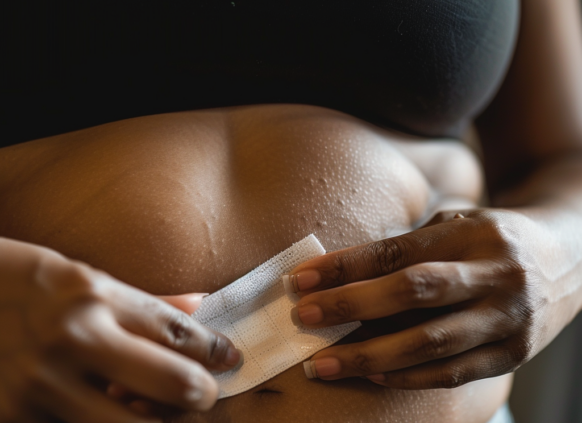
What are weight loss patches – and how do they work?
Weight loss patches, like GLP-1 patches, claim to help people lose weight when applied to the skin. It’s not unrealistic – there are medications delivered effectively transdermally (through the skin), like:
- Local pain treatment
- Hormone replacement therapy
- Nicotine patches to quit smoking
However, there are currently no weight loss patches proven to work.
How are they supposed to work?
Weight loss patches are designed to release active ingredients over several hours, which are then absorbed through the skin into the body.
They are supposed to:
- stimulate fat burning,
- boost metabolism, and/or
- suppress appetite.
They typically contain a combination of extracts, natural substances, and active ingredients like:
- Berberine
- Turmeric
- Brown algae extract
- Guarana
- Bee venom
- Caffeine
- Flaxseed extract
- L-carnitine
- 5-HTP
Studies suggest that the ingredients listed above may have some effect on weight management when taken as oral supplements – but this impact is small.
As for patches, it’s unclear whether these ingredients can even pass through the skin, and that would be the most basic requirement for a weight loss patch to work.
Even when they are marketed as GLP-1 patches, they do not contain the active ingredients found in clinically-proven weight loss medication like Wegovy and Mounjaro.
Common types of weight loss patches
| Type of patch | What it claims to do | Evidence |
| Fat-burning patches | Increase calorie or fat burning | No credible evidence |
| Appetite suppressant patches | Reduce hunger or cravings | No credible evidence |
| Metabolism patches | Boost metabolism | No credible evidence |
| Detox patches | Remove toxins or water weight | No credible evidence |
| Herbal/vitamin patches | Deliver plant extracts or nutrients through skin | No credible evidence |
| GLP-1 patches | Mimic GLP-1 injections | No credible evidence |
What are GLP-1 weight loss patches?
GLP-1 patches are a newer type of weight loss patch marketed as a needle-free alternative to medicines like Wegovy and Mounjaro. However, over-the-counter GLP-1 patches do not contain semaglutide, tirzepatide or any licensed GLP-1 receptor agonist.
Where do you apply weight loss patches?
If the ingredients in weight loss patches worked mainly in a local area, it would make sense to apply them to parts of the body with more fat tissue, such as the stomach or thighs.
If the ingredients spread throughout the body via the bloodstream, the exact location would matter less. In that case, the patch could also be applied to the back, chest, or arms.
It’s important not to apply patches to damaged, sore, or irritated skin.
It’s not known if the ingredients in weight loss patches enter the body at all or how they might spread once there.
At the moment, there is no good-quality evidence showing that the ingredients in weight loss patches enter the body in meaningful amounts or help people lose weight.
So, based on the evidence currently available, weight loss patches are unlikely to be an effective way to lose weight.
Is there any evidence that weight loss patches work?
No – proof they work would include clinical studies that reviewed whether they lead to weight loss, ideally compared with placebo.
These studies do not exist.
The weight loss patches sold online have not been properly tested, and it is unlikely that they have any meaningful impact. Some may even contain toxic ingredients, such as chromium, which is not approved for weight reduction.

What does research say?
Researchers are looking into effectively delivering weight loss medication through the skin, but these are still in development.
Some studies have tested transdermal patches containing microneedles. These deliver active ingredients through tiny punctures in the skin. They are designed to stimulate the conversion of white fat tissue into brown fat tissue, as the body burns brown fat tissue to generate heat. They have shown to lead to fat loss in initial testing.
So, there’s a lot of testing underway, and it’s possible that effective weight loss patches may exist one day, but not yet.
Warnings from consumer protection organisations
The Consumer Health Protection Centre warns on Instagram about weight loss patches – especially so-called GLP-1 patches, which claim to work like weight loss injections such as Saxenda, Wegovy, or Mounjaro.
Consumer advocates describe them as misleading and have even called them a “rip-off.”
These patches do not contain GLP-1s, like Wegovy or Mounjaro.
There’s no evidence to show these patches have any effect on weight loss.
What are the risks of weight loss patches?
Weight loss “GLP-1” patches are typically sold as food supplements or cosmetic products rather than medicines, so they have much lower safety standards.
They also do not need to be proven to work before they can be sold.
Skin irritation and allergic reactions are very possible, and toxic effects on the body cannot be ruled out (especially with long-term use).
What actually gets results?
Do you want to lose weight and keep it off long term?
Oviva’s personalised weight loss programme helps people lose 15% of their body weight over 12 months, on average. For someone weighing 120 kg, that’s equivalent to losing 18 kg!
And the best part? You can forget restrictive diets, extreme exercise, rigid rules, self-blame and yo-yo dieting.
Instead, with the support of your own health coach, you’ll get an evidence-based weight loss plan that looks like:
- Lifestyle changes you can maintain long term
- Nutritious food you enjoy
- Movement and exercise that fits into your daily life and feels good
- Self-care and a positive mindset
And, if appropriate, you could get weight loss medication like Wegovy delivered to your door.
Oviva works, which is why it’s covered by the NHS.
-
 Type 2 diabetes
What is the best diet for insulin resistance?
-
 Weight loss support
Orforglipron: everything you need to know about the new weight loss pill
-
 Weight loss support
Hashimoto’s diet: what to eat and avoid + how nutrition can support your thyroid